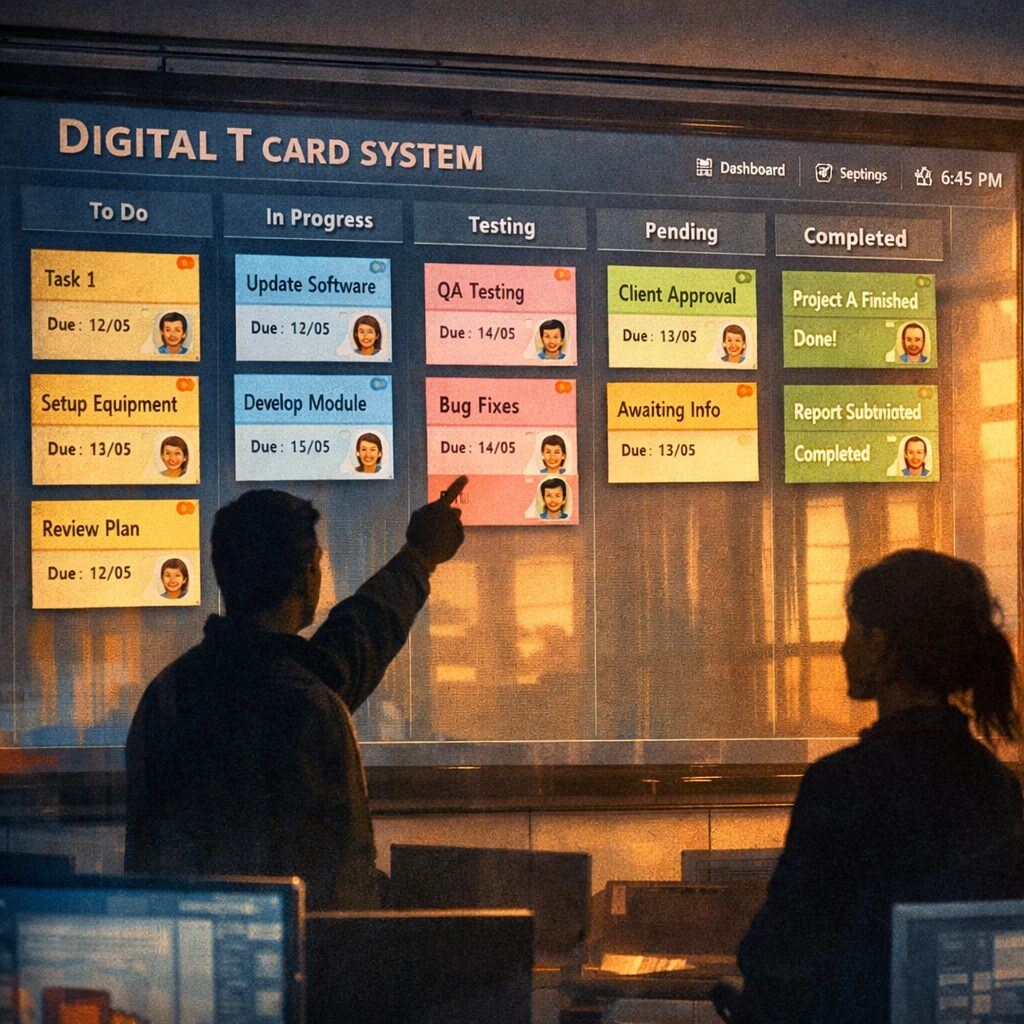
What is a Digital T Card System?
A Digital T Card System is a modern, electronic adaptation of the traditional paper T card method used for tracking tasks, equipment, people or jobs across shifts and workflows. Instead of physical cards slotted into boards, a digital system represents each T card as a virtual entity with fields for status, priority, owner, timestamps and custom metadata. The system preserves the intuitive left-to-right progression of tasks and the visual clarity of the classic T card while adding search, history and automation capabilities.
In practice, a Digital T Card System functions as a lightweight workflow engine: cards move between columns or states, supervisors can quickly see outstanding items, and teams can record handovers and comments. This makes it ideal for environments that rely on visual, card-based control but need the flexibility and remote access that only software can provide.
How a Digital T Card System Works
At its core a Digital T Card System models cards, columns (or lanes), and transitions. Each card contains key attributes — a unique ID, description, owner, due date, priority and a history log — and can be filtered or sorted based on these fields. Users interact with cards through drag-and-drop boards, forms and context menus, mirroring the tactile experience of physical T cards.
Behind the interface, the system typically relies on real-time synchronisation and a database that captures state changes. When a card moves from one column to another, triggers can fire: notifications to stakeholders, automatic timestamping for shift handovers, or rules that prevent a card from progressing until required checks are completed. This rule-based behaviour makes the Digital T Card System more robust than paper while retaining the familiar visual semantics of a T card layout.
Key Benefits of Using a Digital T Card System
Visibility and accountability improve immediately: everyone with access sees current card locations and owners, reducing the need for verbal updates or walk-rounds. The digital format also provides an audit trail so you can review who moved a card, when and why.
Another benefit is scalability. Where physical boards are limited by space and geography, a Digital T Card System scales across multiple sites and teams. Advanced search, tagging and reporting let managers analyse bottlenecks and cycle times. Additionally, integration with notifications, calendars and mobile devices ensures shift handovers and urgent tasks are handled promptly.
Finally, the ability to automate common actions — for example, escalate overdue cards or auto-assign based on skillset — reduces manual overhead and error, which is especially valuable in high-turnover or 24/7 operations.
Implementing a Digital T Card System in Your Workplace
Start by mapping your existing paper T cards: identify card types, standard fields, typical transitions and any mandatory checks. Replicate these elements in the digital model so users recognise the workflow immediately. Begin with a pilot team to validate card templates and transition rules, then iterate based on feedback.
Training should focus on the continuity between physical and digital processes: how to read a card, how to perform a handover, and how to use the history log. Establish governance for naming conventions and archiving to maintain clarity as the number of cards grows. Finally, set measurable success criteria — such as reduced handover time or fewer lost tasks — to demonstrate the value of the Digital T Card System.
Integrations, Tools and a Practical Example
A Digital T Card System reaches its full potential when integrated with other tools: calendar systems for due dates, messaging platforms for alerts, and asset registers for equipment-linked cards. Many modern project systems already support kanban and scrum boards and can be configured to emulate T card behaviour.
For teams exploring options, services like onlinetcards.com offer free project management features with kanban and scrum boards that can be adapted into a Digital T Card System. Using such platforms, you can create card templates, automate transitions and allow remote teams to collaborate in real time — all without building custom software from scratch.
Security, Compliance and Data Retention for Digital T Card Systems
When moving from paper to digital, consider access control carefully: role-based permissions ensure only authorised staff can modify or close cards. Audit logs are essential for regulatory compliance and for analysing incident chains in safety-critical environments. Ensure encryption in transit and at rest, and review a provider’s data retention policies so historical cards remain available for the required period.
If you handle personal or sensitive information on cards, apply data minimisation and anonymisation where possible. Regular backups and export capabilities will prevent data loss and allow migration between systems should your organisation change tools in future.